Friday, July 15, 2011

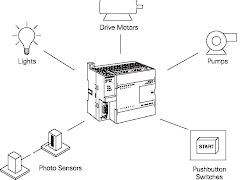
Pengertian PLC


P = Programable
Adalah menunjukkan kemampuan dalam hal memori untuk menyimpan program yang telah dibuat yang dengan mudah diubah ubah fungsi dan kegunaannya.

PLC
L = Logic
Adalah menunjukkan kemampuan dalam memproses input secara aritmatik dan logic,yakni melakukan operasi membandingkan,menjumlahkan,mengalikan,mengurangi,dan/AND,atau/OR,perwaktuan//timer,penghitungan/counter dlsb.

C : Controller
Adalah menunjukkan kemampuan dalam mengontrol dan mengatur proses,sehingga menghasilkan keluaran/output yang diinginkan.

Menurut National Electrical Manufacturing Assosiation (NEMA),PLC didifinisikan suatu perangkat elektronik digital dengan memori yang dapat diprogram untuk menyimpan instruksi instruksi yang menjalankan fungsi fungsi spesifik seperti :logika,sequen,timing,counting dan aritmatika,untuk mengontrolsuatu mesin industri atau proses industri sesuai dengan yang diinginkan.PLC mampu mengerjakan suatu proses terus menerus sesuai variable masukan dan memberikan keputusan sesuai keinginan pemrograman,sehingga nilai keluaran/output tetap terkontrol.

Menurut Forum Sains.Com PLC merupakan”Komputer khusus”untuk aplikasi dalam industri untuk memonitor proses dan untuk menggantikan Hard Wiring Control dan memiliki bahasa pemrograman sendiri.Akan tetapi PLC berbeda dengan perangkat computer,karena PLC dirancang untuk instalasi dan perawatan oleh tehnisi dan ahli listrik di industri yang tidak harus mempunyai kemampuan elektronika tinggi dan memberikan kendali yang fleksible berdasarkan eksekusi instruksi logika.

Menurut CAPIEL 1982,PLC adalah system electronic yang beroperasi secara digital dan didesain untuk pemakaian di lingkungan industri,dimana system ini menggunakan memori yang dapat diprogram untuk penyimpanan secara internal instruksi instruksi yang mengimplementasikan fungsi fungsi spesifik seperti logika,urutan,perwaktuan,pencacahan dan operasi aritmatik untuk mengontrol mesin atau proses melalui modul modul I/O digital maupun analog.

Read more >>

Monday, June 27, 2011

Tank level Sensor With PLC

Where can an instrument access the tank?  top, bottom, low on the side?  Access and/or mounting is a major consideration

- Ultrasonic or radar: non-contact, top mounted.  Ultrasonic has a dead zone at some distance ( <12") beneath face of the transducer where it can't read the echo signal.   I've heard that technically, level-radar is supposed to be used in metal tanks by some federal regulation or other, but the level-radar police do not appear to have been very active.  If you're next door to an airport they might be, though.

- submersible head pressure: pressure transmitter on a long cable with a vent tube attached for atmospheric reference is dropped into the tank from the top

- bubbler: top mounted; a tube with a v notch in the bottom that bleeds air bubbles from a differential air regulator. The back pressure in the tube equals the head pressure of the column of water.   Requires continuous stream of dry air.

- capacitance: a rod inserted from the top measures level due to capacitance of water.   Plastic tanks require a metal reference rod as part of the inserted rod assembly.

- pressure transmitter: plumbed to an access port near the bottom of the tank, reads the head pressure above the elevation of the access port (assuming transmitter is at same elevation as the access port)

- bypass sight gauge: plumbs to bottom or low side of tank.  Magnetic float flips a series of visual indicator flags.   All vendors offer some sort of optional electronic gizmo for creating a 4-20mA signal.


- level by weight
load cells weigh the tank and its contents, electronics subtract out the weight of the tank, leaving the weight of the water.  Those never-tiring electronic gnomes do some arithmetic on tank dimensions to create a level value.


From
Read more >>

Tuesday, March 29, 2011

About Software Avr Studio


AVR Studio is an Integrated Development Environment (IDE) for writing and debugging AVR applications in Windows 9x/Me/NT/2000/XP environments.  AVR Studio provides a project management tool, source file editor, chip simulator and In-circuit emulator interface for the powerful AVR 8-bit RISC family of microcontrollers.
In addition, AVR Studio supports the STK500 development board, which allows programming of all AVR devices, and the new JTAG on-chip emulator.  
AVR Studio 4 has a completely new modular architecture which allows even more interaction with 3rd party software vendors.  GUI plug-ins and other modules can be written and hooked to the system.  Please contact us if you are interested in more information about this.

Read more >>

Tuesday, February 22, 2011

Gesture-controlled computers and robotic nurses being developed for operating rooms

lthough surgeons need to frequently review medical images and records during surgery, they’re also in the difficult position of not being able to touch non-sterile objects such as keyboards, computer mice or touchscreens. Stepping away from the operating table to check a computer also adds time to a procedure. Researchers from Indiana’s Purdue University are addressing this situation by developing gesture-recognition systems for computers, so that surgeons can navigate through and manipulate screen content simply by moving their hands in the air. The system could additionally be used with robotic scrub nurses, also being developed at Purdue, to let the devices know what instruments the surgeon wants handed to them.
The system incorporates a Microsoft Kinect camera (yes, from the gaming system) and specialized algorithms to recognize hand gestures as instructions.
“One challenge will be to develop the proper shapes of hand poses and the proper hand trajectory movements to reflect and express certain medical functions,” said Juan Pablo Wachs, an assistant professor of industrial engineering. “You want to use intuitive and natural gestures for the surgeon, to express medical image navigation activities, but you also need to consider cultural and physical differences between surgeons. They may have different preferences regarding what gestures they may want to use.”

There are also other considerations that the researchers are taking into account in the design of the system. For instance, they don’t want surgeons to be required to wear special types of gloves or colors of clothing in order for their hands to be “read.” The system should also be able to recognize and respond to gestures quickly, and provide confirmation that it understands the request. At the same time, however, it should not accidentally respond to extraneous gestures, such as those made to colleagues in the room.
The Purdue team also want the system to be relatively inexpensive, and to be quickly and easily adaptable to different operating rooms, lighting conditions, and other variables.
The system could be particularly effective when combined with the robotic scrub nurses, although they wouldn’t be intended to replace human nurses in all situations. “While it will be very difficult using a robot to achieve the same level of performance as an experienced nurse who has been working with the same surgeon for years, often scrub nurses have had very limited experience with a particular surgeon, maximizing the chances for misunderstandings, delays and sometimes mistakes in the operating room,” Wachs said. “In that case, a robotic scrub nurse could be better.”
While other groups have also researched the use of robotic scrub nurses, Wachs claims that his is the first to look into the incorporation of gesture – instead of voice – recognition. The Purdue system is also apparently unique in that it uses advanced algorithms to predict where the surgeon’s hands will be next, or what screen images will next be requested.

Read more >>

Monday, February 21, 2011

Killzone 3 reviewed: PlayStation Move gets serious

When I reviewed PlayStation Move last year, I named Killzone 3 as one of the games that would show us whether Move controllers were destined to gather dust in the cupboard or play an important role in the longevity of the PlayStation 3 platform. It is unquestionably the latter.

I've been playing first-person shooters for nearly 20 years, and I've played them with just about every possible input device along the way. I'm not going to say Move is better than a mouse and keyboard, but as far as consoles go, Move is by far the best controller yet...and turns Killzone 3 from a fantastic first-person shooter to the most immersive, visceral experience you'll find on a console today.
I gave Killzone 2 a 95/100 score back in 2009, and a vast majority of what I said in that review applies to the sequel, so I won't bother repeating it here. There's a couple of new (and very cool) weapons, more killer vehicle and fixed weapon sections, the best David vs Goliath boss fight I can remember (which introduces one of those new weapons very well), splitscreen co-operative, and thousands more bad guys to shoot. What more do you need?
The obligatory "I might be gushing but this isn't a perfect game" bit: there's some weird and very frustrating spikes in difficulty (if you don't like dying a lot, don't choose "normal" difficulty), including a confusing level that establishes itself as a stealth level, but then doesn't give you any indication when you get to the bit where stealth isn't going to work anymore. There are also enemies that can kill you in one hit (an FPS faux pas in my books), and you'll see plenty of them. The frequent cinematics are sullied by the fact that many characters and a majority of the dialog are cliched beyond belief. All relatively inconsequential scuff marks on an otherwise very polished game.
Killzone 3 is the kind of game that will sell both Move controllers and PlayStation 3 systems. Unquestionably a must-have title for PlayStation 3 owners even if you don't have Move (though you'd be mad not to grab a single player Move setup at the same time).
Read more >>

Saturday, February 19, 2011

EGO-Kits give downhill mountain bikes a boost

While electric commuting bikes are currently experiencing a surge in popularity, electric mountain bikes such as the Conway E-Rider and the KTM eGnition are also showing up on tradeshow floors with increasing frequency. Most of these are designed as cross-country and/or trail bikes, with the idea that the motor can extend their range above the reaches of pure human power – of course, they might also appeal to couch potatoes who want all the fun of mountain biking, with a minimum of the exercise. The EGO-Kit, however, is an electric motor that can be added onto an existing downhill mountain bike, with the specific purpose of replacing a chair lift for getting bike and rider to the top of the mountain.
The high-torque brushless motor puts out 1200W of nominal power, and 2400W maximum. It’s fed by a 48V lithium-iron phosphate battery, that is carried in an included backpack. That battery charges in 1.5 hours, is good for 1,500 loading cycles, and provides a range of 40 kilometers (25 miles) – although that figure depends highly on the grade of the mountain that’s being climbed.
The motor mounts on the bottom of the down tube, near the bottom bracket. This midships low-center-of-gravity configuration is said to have little effect on the bike’s handling. Its output is determined via a control unit and throttle, mounted on the handlebar. All of the gear, excluding the rider-worn battery, has a combined weight of 4.4 kilograms (9.7 lbs).

The kit is reportedly compatible with about 70 percent of downhill mountain bikes currently on the market. Riders can choose between completely forgoing the motor, using it to assist their pedaling, or using it on its own. At maximum output, it can manage a top speed of 70 kph (43 mph). It is also said to be able to handle inclines of up to 80 percent, although that depends on rider skills, motor temperature and soil conditions.
The EGO-Kit can be purchased through the company website for EUR1,870 (about US$2,520), plus shipping from Germany. A 500W version is also available for EUR1,650($2,225). Sales are slated to begin on April 1st ... no joking.
From
Read more >>

Monday, December 6, 2010

Rangkaian PLL (Phase-Locked Loop)

Pratikum dasar telekominkasi banyak memakai rangkaian PLL.

Apa itu rangkaian PLL ?
PLL kependekan dari 'Phase-Locked Loop' pada dasarnya adalah sebuah sistem kontrol frekuensi yang memanfaatkan sensitivitas deteksi fasa antara sinyal input dan output dari sebuah rangkaian osilasi yang terkontrol.tikum

rangkaian ini banyak dipakai dalam pratikum dasar telekomunkasi hal ini cukup membuat saya tertantang dengan alat ini. walaupun hanya sekedar simulasi sinyal yang akan di cobakan. Tetapi cukup mewakili teori yang diajarkan didalam kelas.

Rangakain ini terdiri dari VCO
Rangkaian VCO akan terus berosilasi menghasilkan frekuensi f2 sampai f2 = f1. Ketika f2 = f1, maka tegangan Vdc keluaran rangkaian phase detector = 0 dan ini menyebabkan rangkaian VCO berhenti berosilasi (locked). Karena rangkaian loop ini akan mengunci (Locked) saat frekuensi dan fasa dari kedua sinyal sama, maka rangkaian ini disebut dengan Phase-Locked Loop.

Read more >>

Friday, November 26, 2010

Dual Regulated Power Supply High Current

The circuit given here is of a regulated dual power supply that provides +12V and -12V from the AC mains. A power supply like this is a very essential tool on the work bench of an electronic hobbyist.
The transformer T1 steps down the AC mains voltage and diodes D1, D2, D3 and D4 does the job of rectification. Capacitors C1 and C2 does the job of filtering.C3, C4, C7and C8 are decoupling capacitors. IC 7812 and 7912 are used for the purpose of voltage regulation in which the former is a positive 12V regulator and later is a negative 12V regulator. The output of 7812 will be +12V and that of 7912 will be -12V.


circuit Dual Regulated Power Supply High Current


Read more >>

Thursday, November 25, 2010

Free Switch Mode Pre-Regulator

The botheration was that a voltage regulator had to bead the 18 volt capital ability accumulation voltage to 8 volts at 500ma to ability the CD player, crumbling 5 watts of ability and causing a lot of calefaction central the bunched unit. This ambit acts as an interference-free pre-regulator to abundantly abate the ability loss..
The achievement voltage of this ambit is artless by ability band fluctuations. Amount voltage aberration is alone abased on the on-resistance of Q2 and the amount of C2 (re: ripple). The achievement voltage can be set so that the ripple lulls are aloof aloft the drop-out voltage of the beeline regulator at best amount for best activity conservation. The college amount you aces for C2, the added activity you can save and the added abiding the pre-regulator’s achievement voltage.
circuit  Free Switch Mode Pre-Regulator

Read more >>

Wednesday, November 24, 2010

78XX Family Regulators Universal PCB for PSU

Many DIY projects require a small Power Supply.
The 78XX family is ideally suited for this job, and with this little PCB you can easily build small Power Supplies for virtually every application.
The circuit is very simple:
The Alternating current is applied to X1 and rectifies by B1.
It charges a large Capacitor C1 to power the regulator.
The output voltage depends on the Regulator you use, e.g. 7805, 7812,7815…
Dimensionierung:
C1:4700u, with sufficient voltage Rating!
C2:0.33u
C3:0.1u
The Heatsink should be enough for devices with moderate power consumption.
Read more >>